How Social Battery Badges Help Neurodivergent Adults Communicate Boundaries (Without Saying a Word)
Reading Time: 8 minutes
You finish a meeting and your brain feels like static. Someone asks if you’re free for coffee. Your chest tightens. You know you should say “I’m completely drained and need silence,” but instead you hear yourself say “Maybe later?” and spend the next hour avoiding everyone while feeling guilty about it.
If that sounds familiar, you’re not alone. Research from 2025 shows that neurodivergent people often don’t recognise energy depletion until they’ve already surpassed their limits. Unlike neurotypical people, autistic and ADHD adults experience social interactions as significant cognitive work that drains limited energy reserves. The neurodivergent community describes this using Spoon Theory, where “spoons” represent daily energy units consumed by executive functioning, sensory processing, and social demands.
The challenge? Communicating “I’m running on empty” requires the exact cognitive resources you’ve already depleted.
Social battery badges solve this problem. These simple visual tools let you signal your current energy state without verbal explanation, helping prevent burnout before it reaches shutdown or meltdown.
What Are Social Battery and Mood Tracker Badges?
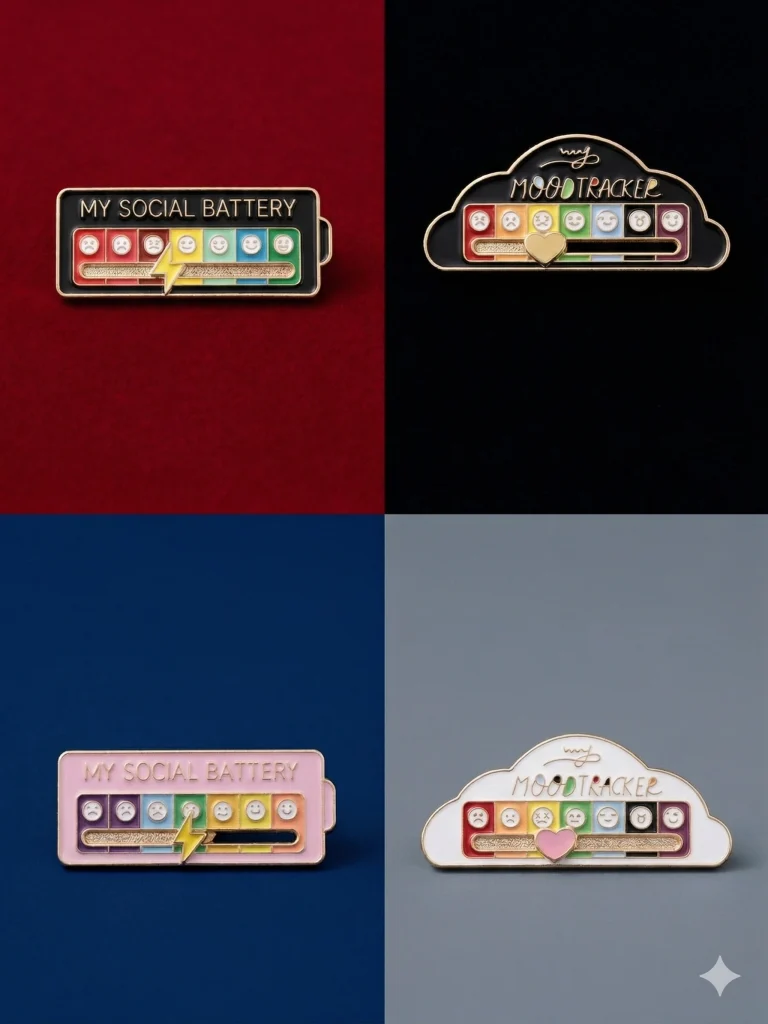
Social battery badges are wearable pins featuring emoji faces ranging from depleted (red, exhausted) to fully charged (green, energised). Mood tracker badges use a similar visual spectrum to communicate current emotional state.
Think of them as an energy fuel gauge you wear. Instead of forcing yourself to articulate complex internal states when you’re already overwhelmed, you point to your badge or let others see it naturally.
The concept isn’t new to the neurodivergent community. Christine Miserandino’s Spoon Theory has been widely used since 2017 to describe variable daily energy levels influenced by sensory input, executive functioning demands, and social interactions. These badges simply make that internal experience externally visible.
The Research Behind Social Battery Depletion in Neurodivergent People
This isn’t about being “antisocial” or lazy. Neurodivergent brains process social interaction differently at a neurological level.
Social Interactions Require Significant Cognitive Resources
For autistic and ADHD adults, what neurotypical people experience as casual interaction demands intense mental effort. You’re simultaneously processing:
Verbal content and implied meanings
Facial expressions and body language
Social rules and expected responses
Sensory input (lighting, sounds, textures)
Executive function (organising thoughts, managing impulses, tracking time)
Research from 2025 shows that executive functioning tasks, social interactions, sensory processing, and communication demand significant cognitive resources for neurodivergent people, necessitating intentional planning to conserve energy.
Masking Accelerates Energy Depletion
Masking (suppressing autistic or ADHD traits to appear neurotypical) requires constant cognitive and emotional effort. A 2024 study found that masking significantly predicted anxiety, depression, and stress, sometimes more strongly than autistic traits themselves.
When you’re masking, you’re running two operating systems simultaneously: your natural neurodivergent processing and the forced neurotypical presentation. That’s exhausting.
Research from 2025 confirms masking creates disconnection between internal state and external presentation, increasing stress and anxiety. The effects include shutdown, burnout, depression, exhaustion, and increased mental health deterioration.
Unlike Neurotypicals, You May Not Recognise Depletion Until It’s Too Late
This is crucial. Research shows that autistic individuals often don’t recognise energy depletion until they’ve surpassed their limits. You’re not “bad at boundaries.” Your brain processes energy feedback differently.
By the time you consciously notice “I’m completely drained,” you may have already entered burnout territory where even basic self-care becomes difficult.
7 Benefits of Using Social Battery Badges
1. Communicate Boundaries Without Verbal Explanation
When your social battery is depleted, articulating “I need space but it’s not about you and I’m not angry I’m just overwhelmed” requires cognitive resources you don’t have.
A badge showing you’re in the red zone communicates this instantly. No explanation needed. No risk of sounding rude or having to manage others’ emotional reactions to your needs.
This is particularly valuable for people who struggle with alexithymia (difficulty identifying your own emotional state). The badge provides an external reference point when internal awareness is unclear.
2. Prevent Burnout Before Reaching Shutdown or Meltdown
A systematic review of 48 studies involving approximately 4,000 autistic people found that burnout is characterised by chronic exhaustion, loss of functioning, and recurring crises, often linked to social overload and everyday demands, with rest as a key protective factor.
Social battery badges function as an early warning system. When you’re in yellow or orange territory, you know to implement recovery strategies before hitting complete depletion.
For many neurodivergent people, meltdowns or shutdowns happen because they pushed past their limits without recognising the warning signs. Visual tracking makes those patterns visible.
3. Reduce Pressure to Mask Your Actual State
Masking is harmful. Research from 2025 confirms that no therapeutic or educational approach should ever encourage masking as a goal, as it leads to shutdown, burnout, and increased mental health problems.
Wearing a social battery badge gives you permission to be authentic about your capacity. It legitimises “I’m depleted” as a valid state that doesn’t require justification or apology.
Colleagues, friends, and family can see your badge and adjust accordingly without you having to perform enthusiasm you don’t have. That removes the exhausting cycle of pretending you’re fine when you’re not.
4. Workplace Accommodation and Communication Tool
In UK workplaces, autism and ADHD can qualify as disabilities under the Equality Act 2010. Employers must make reasonable adjustments to prevent substantial disadvantage.
Social battery badges can function as a reasonable workplace accommodation. They provide colleagues with clear, non-confrontational information about your current capacity for interaction.
Research from 2025 surveying 880 workplace employees found that 60.6% say their workplaces are inadequately adapted for neurodivergent staff. Simple visual communication tools can bridge this gap.
For employed individuals, Access to Work funding can provide up to £66,000 annually for workplace adjustments and support. While badges themselves are affordable (£5), the principle of visual communication as accommodation is supported by this framework.
5. Build Self-Awareness About Energy Patterns
Many neurodivergent adults struggle to recognise their own patterns because they’ve spent years masking and ignoring internal signals.
Using a social battery badge forces conscious check-ins: “What’s my energy level right now?” Over time, you build awareness of:
Which activities drain you fastest
How much recovery time you actually need
Daily energy patterns (morning person vs evening person)
Warning signs before complete depletion
This data becomes actionable. You can schedule demanding tasks during high-energy periods and protect low-energy times for recovery.
6. Set Boundaries Without Guilt or Shame
Research shows that neurodivergent people often face dismissal of their social and sensory needs because masking makes them appear “fine.” This creates pressure to continue beyond your actual capacity.
A badge makes your needs externally visible and legitimate. “My badge is red” is a factual statement, not a personal failing or weakness.
For people who struggle with people-pleasing or feel guilty about needing space, the badge provides external validation: “This is real. My need for rest is legitimate.”
7. Help Others Support You Effectively
Most people genuinely want to support neurodivergent colleagues, friends, and family members. They just don’t know what you need because you’re masking successfully.
Social battery badges solve the invisible disability problem. They give others actionable information:
Red badge = This person needs quiet and minimal interaction
Yellow badge = They’re managing but capacity is limited
Green badge = They have energy for social engagement
This prevents well-meaning people from inadvertently draining you further while thinking they’re being friendly.
How to Use Social Battery Badges Effectively
At Work
Pin your badge to your lanyard, bag, or clothing where colleagues can see it. Brief your team once: “I’m using a social battery badge to communicate my capacity for interaction. When it’s red or orange, I need minimal conversation. It’s not personal, it helps me work sustainably.”
Most colleagues will appreciate the clear communication. It removes guesswork and awkward social navigation for everyone.
At Home
Use badges with family members or housemates. This is particularly valuable for partners of neurodivergent people who want to support but don’t know when interaction is helpful versus draining.
Research from 2025 on neurodivergent friendships highlights that “social battery drain” makes consistent friendship maintenance challenging. Visual tools reduce the emotional labour of repeatedly explaining your needs.
In Social Settings
Wear your badge to gatherings, events, or any situation where people might initiate interaction. It provides a gentle, non-confrontational way to signal “I’m here but need space.”
For neurodivergent people who experience shutdown (withdrawal, reduced communication, unresponsiveness to overwhelming stimuli), visible signalling can prevent others from misinterpreting your state as rudeness or disinterest.
Pair With Other Strategies
Badges work best alongside other burnout prevention approaches:
Schedule recovery time after social demands
Use noise-cancelling headphones or quiet spaces
Practice saying no without justification
Build routines that honour your energy patterns
Research confirms that when energy reserves are depleted, self-compassion, strategic rest, and delegation become essential in preventing burnout and shutdown.
Who Benefits Most From Social Battery Badges?
Neurodivergent Adults Who Mask Heavily
If you appear “fine” in public but collapse completely at home from exhaustion, these badges can help you stop pushing past your limits.
People Experiencing Burnout
A 2025 systematic review found that autistic burnout includes chronic exhaustion, loss of functioning, and recurring crises. Early signalling of depletion helps implement rest before reaching crisis.
Workplaces Supporting Neurodivergent Employees
Creating neurodiversity-affirming cultures requires accommodations that actually work. Visual communication tools are simple, affordable, and effective.
Anyone Struggling to Communicate Boundaries
Even if you’re not formally diagnosed, if you experience social exhaustion that others don’t understand, badges provide legitimate external validation of your needs.
Where Coaching Comes In
Social battery badges address communication and immediate boundary-setting. But if you’re experiencing chronic burnout, repeated shutdowns, or struggling to build sustainable routines, coaching addresses root causes.
ADHD and autism coaching helps you:
Understand your specific energy patterns and triggers
Build personalised systems around how your brain actually works
Develop emotional regulation strategies
Address workplace challenges and reasonable adjustment requests
Create recovery routines that prevent burnout
For employed or self-employed people in the UK, Access to Work provides up to £66,000 annually for workplace coaching and support at no cost to you or your employer.
One-on-one ADHD coaching combines practical strategy with understanding of neurodivergent functioning. Unlike therapy that focuses on mental health treatment, coaching builds sustainable systems for daily life.
Get Your Social Battery Badge
Social battery and mood tracker badges are available for £5. They’re a simple, affordable tool that can make immediate difference in how you communicate your needs.
Remember: Visual communication tools work best when paired with broader support. If you’re struggling with burnout, executive function challenges, or workplace difficulties, explore coaching options that address underlying patterns.
The Bottom Line
Neurodivergent people aren’t lazy or antisocial. Your brain processes social interaction as genuine cognitive work that depletes limited energy reserves. Research confirms this isn’t in your head; it’s neurological reality.
Social battery badges provide external visibility for internal experience. They remove the exhausting cycle of verbal explanation when you’re already depleted, legitimise your need for rest without shame, and give others clear information about how to support you.
Combined with coaching that builds sustainable routines and understanding of your specific patterns, visual tools become part of a broader strategy for preventing burnout and functioning authentically.
You deserve to communicate your needs without apology. A £5 badge can make that significantly easier.
Medical Disclaimer: This article provides educational information about neurodivergent experiences and communication tools. It is not medical advice and does not replace professional assessment, diagnosis, or treatment. If you’re experiencing burnout, mental health difficulties, or need support, consult qualified healthcare providers. For ADHD or autism assessment in the UK, speak with your GP about NHS referral or consider private assessment options.
Access to Work Information: Access to Work is a UK government scheme providing funding for workplace adjustments. Eligibility and funding amounts vary based on individual circumstances. Visit gov.uk/access-to-work for current information or contact the Access to Work helpline.
Word Count: 2,487 words
Reading Level: Accessible to general audience, research-backed without academic jargon
For decades, ADHD has been popularly described as a “dopamine deficiency disorder.” You’ve probably heard it: “ADHD brains don’t have enough dopamine, so medication tops it up.” It’s simple. It’s
You need to file your taxes. The paperwork sits on your desk, untouched for weeks. You want to do it. You know you should do it. You’re stressed about not
The restaurant is loud. Fluorescent lights hum overhead. Someone’s perfume hits you like a wall. Your brain screams at you to leave but everyone else seems fine, chatting and laughing
Reading Time: 8 minutes You finish a meeting and your brain feels like static. Someone asks if you’re free for coffee. Your chest tightens. You know you should say “I’m